
Angela Regan
Angela Regan, Lead Housing Case Manager at Plymouth, has met some residents during two very different chapters of their lives.
Before joining Plymouth Housing, Angela worked at a shelter in Seattle, supporting people who had spent years living outside. She remembers people arriving exhausted but uneasy; their minds and bodies still focused on survival.
At Plymouth, Angela encountered some of those same people as residents. This time, she saw them during a very different chapter of their lives, talking excitedly about their apartments and beginning to imagine what could come next.
For Angela, seeing that change reinforced something she had learned throughout her work: Having a home does more than provide physical safety. It can give someone the space to finally feel safe.
Living in survival mode
The shelter was Angela’s first experience working closely with people transitioning from living outside toward housing.
There, she saw how years of homelessness could shape people’s routines and sense of safety. Some older adults, for example, were hesitant to move into housing because they were afraid of being alone after years of living around other people. For Angela, it was a reminder that finding a home was a major transition, and that feeling safe and settled could take time.
A shelter helps someone in crisis. Housing with integrated support gives people a stable home and ongoing support as they move forward. Both are vital to addressing our region’s homelessness crisis.
Seeing familiar faces again
Angela remembers how closely the need to stay alert shaped people’s routines. Many carried everything important in backpacks that rarely left their bodies and even slept on them at night.
Years later, after Angela joined Plymouth, she began recognizing familiar names among people moving into Plymouth buildings and at the Plymouth Supply Center. “They saw me and yelled ‘Miss!’ and I yelled back their names and gave them a huge hug,” Angela said.
The difference struck her immediately.
People she remembered as constantly guarded were smiling. Some had shaved and dressed up for their trip to the Plymouth Supply Center, where residents can shop for items for their homes, free of charge. People who once carried everything they owned with them had finally put down their belongings. The backpacks that rarely left their sides were nowhere to be seen.
“They were at their house,” Angela said. Their belongings were safe. They had somewhere to return to. And Angela could see people beginning to relax into a different way of living.
“I see them come to life in so many ways,” she said.
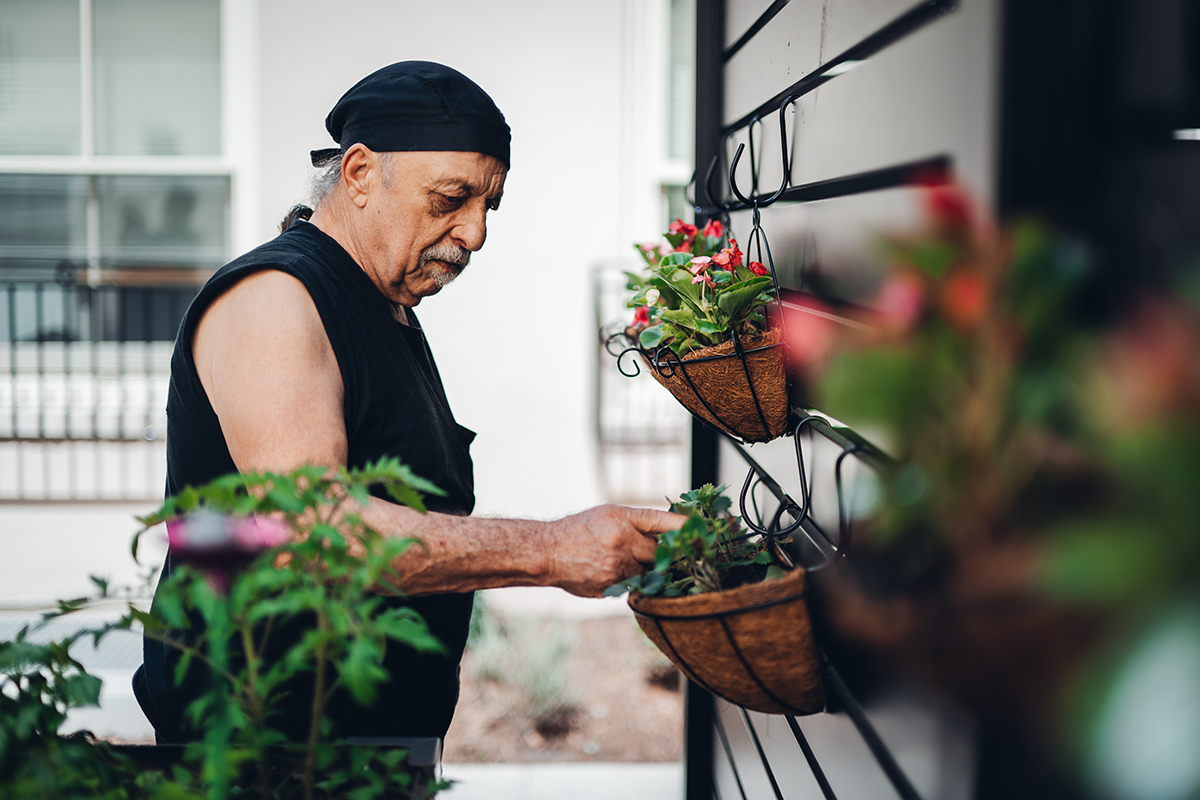
A Plymouth resident enjoys the garden in his building’s courtyard
Meeting the person beyond adversity
One reunion has stayed especially close to Angela.
At the Bridge Shelter, Angela knew a young woman who was often overwhelmed. She carried everything she owned with her and was grieving the death of her father. Angela remembers sitting with her through moments of intense pain. When Angela encountered her again at Plymouth, she was smiling.
The woman told Angela that after moving into her own apartment, she had ended an unhealthy relationship. Angela told her how wonderful it was to see her smile. They hugged, and Angela reminded her of dreams she had shared during their time together at the shelter. “I finally got to meet ‘her,’” Angela said, “not the survivor.”
When someone no longer has to devote so much energy to immediate survival, there can finally be room to think about what they want for themselves. That change does not necessarily happen the moment someone receives the keys to an apartment. After years of instability, learning to trust that a home will still be there tomorrow can take time, but Angela has watched that trust grow.
What becomes possible at home
Angela has now spent years seeing people on both sides of the transition from homelessness to housing.
She has watched people finally sleep well, take care of their health, develop routines, build relationships with neighbors, pursue recovery, and begin thinking about the future. These changes aren’t always immediate or easy. A home cannot erase what someone has experienced, but it can provide something fundamental: a safe place to start.
Angela’s own experiences have shaped the way she approaches her work. She shared that she experienced homelessness at one point in her life and remembers the people who stood beside her. Today, she tries to offer others that same consistency.
“When a person comes to me, they are coming with all their energy and seeking help and support,” Angela said. “That is an honor and should be treated as such.”
After 15 years of working alongside people navigating difficult chapters in their lives, Angela says the work has become part of her purpose. “I had someone who stood with me in my journey, and it is my privilege to be in their journey,” she said.
When Angela sees someone she once knew at the shelter now settled into their own home, she still feels the same thing: “A swelling of joy that they kept going, they did not give up, and I got to be a piece of that journey.” After years spent focused on survival, having a home can offer a place where you can finally let your guard down.