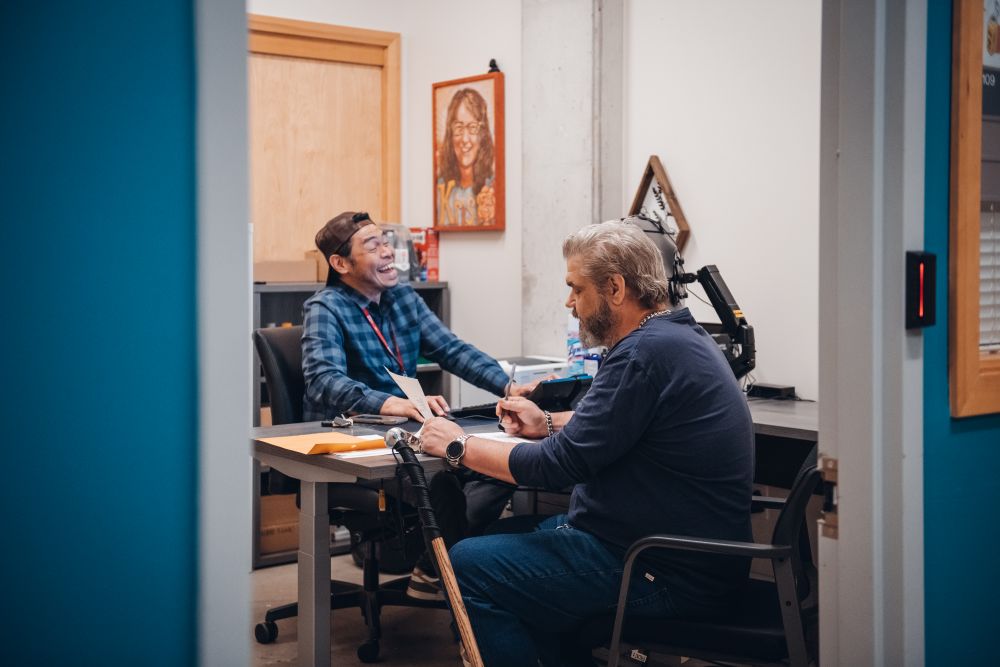
Efren Damian, left, assists a Plymouth resident in his office
In honor of Asian American, Native Hawaiian, and Pacific Islander (AANHPI) Heritage Month, we’re sharing the story of a Plymouth staff member and the experiences they bring to this work.
One of the things that makes Plymouth unique is the people who shape it every day — staff, residents, and supporters bringing a wide range of lived experiences into each building. That mix isn’t incidental. It’s what creates the sense of community our residents rely on to rebuild their lives.
For residents moving into a Plymouth building, that community often begins with someone like Efren Damian.
As a housing case manager, Efren helps residents access the resources and services they need to stabilize after homelessness. He arranges medical care for people with chronic or untreated conditions, connects residents to substance use treatment, supports job searches, and helps individuals plan for what comes next.
He also ensures residents’ homes remain safe and stable, conducting health and safety inspections and working alongside building staff to maintain a healthy living environment.
“My goal is to build positive relationships with residents, provide consistent support, and help create a stable and healthy community,” Efren said.
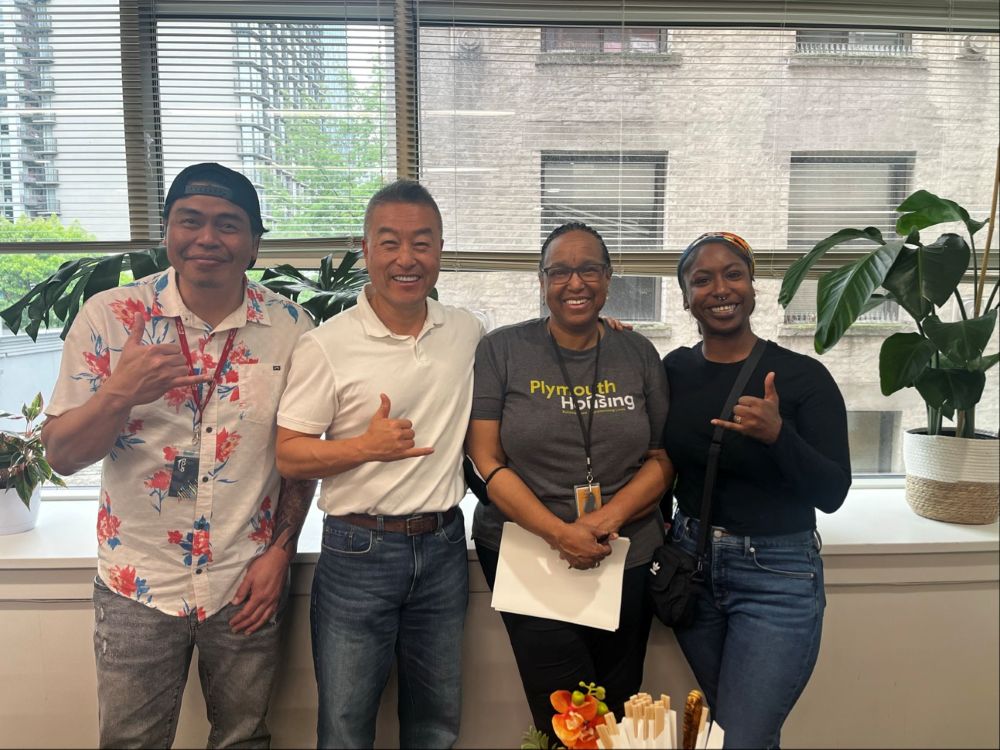
Efren, left, with Plymouth colleagues
Efren began his journey with Plymouth in 2020, working in building operations at historic apartments in downtown Seattle before moving into his current role at a different building near Seattle Center. Through steady relationship-building with both residents and colleagues, he was encouraged to apply for a leadership role in case management — a position he now holds at one of Plymouth’s 18 permanent supportive housing developments across King County.
By “permanent,” we mean there is no time limit on how long someone can stay. By “supportive,” we mean that services like Efren’s are built into daily life, helping residents move toward stability and independence.
That work is what keeps Efren motivated. “Being able to support residents through challenges, help them access resources, and see their progress toward stability and independence is very fulfilling,” he said. Moments of gratitude — when residents recognize their own progress — are especially meaningful.
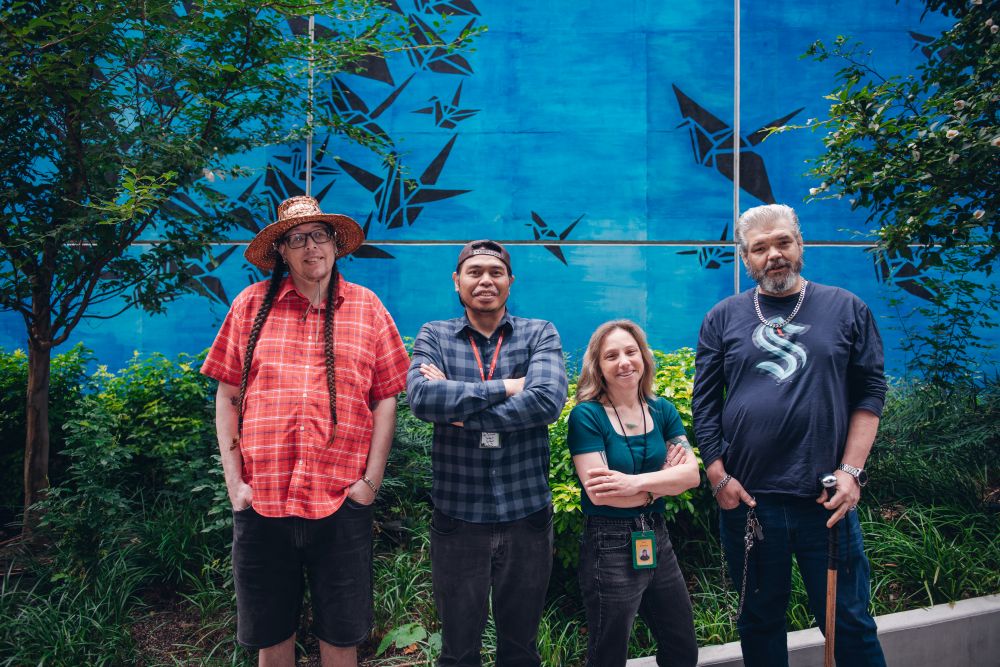
Efren, second from left, with Plymouth residents and staff
Efren’s approach to community didn’t begin at Plymouth. It’s rooted in his upbringing and the cultures that shaped him. “I am full Filipino,” he explains, “but I use both Guamanian and Filipino as my ethnicity.”
Born and raised in Guam, Efren grew up surrounded by a blend of cultural traditions that reflect the island’s deep connections across the Pacific. His family’s story is part of that history: in the 1950s, his aunt moved from the Philippines to Guam for work, eventually helping bring the rest of the family there.
As a child, Efren remembers celebrating Santo Niño each January, a festival honoring his family’s roots in Pandacan, a neighborhood in Manila. Over time, those traditions evolved, and his connection to community took on new forms closer to home.
“I started to celebrate my local side (Guamanian), which consisted of several barbecues — whether it was held at a friend’s house or at the beach,” he said. “Mostly the beach.” Efren also participated in seasonal festivals in Guam that celebrated Japanese culture, like Haru Matsuri in the spring and Aki Matsuri in the fall.
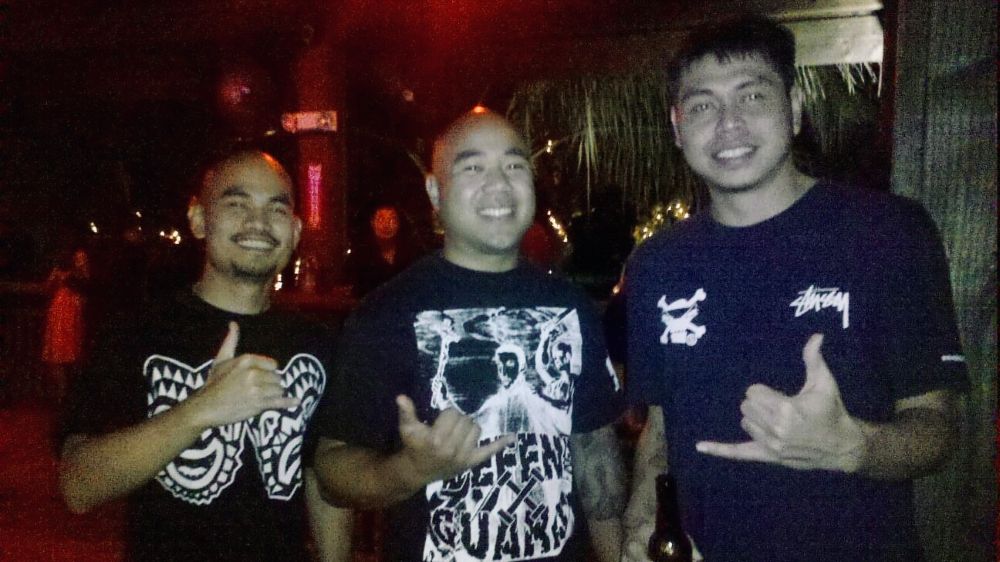
Efren, left, spent his youth in Guam
Today, he continues to explore that multicultural heritage through learning to cook dishes like sinigang (a Filipino soup with a sour broth), Chamorro red rice and tinaktak (traditional Guamanian dishes), and katsu (Japanese breaded, deep-fried cutlets).
Efren’s experiences — gathering with others, sharing food, and building connections across cultures — show up in how he approaches his work. Every day, he meets residents where they are, recognizes the unique experiences they bring, and helps create a space where housing can grow into a sense of home.