In 1980, members of downtown Seattle’s Plymouth Congregational Church were deeply concerned when they realized people were sleeping on their church doorstep. Their pastor, Rev. David Colwell, didn’t see a nuisance — he saw neighbors in crisis. He challenged his congregation with a simple but powerful truth: “One homeless person is one too many.”
To Colwell, the real issue wasn’t that unhoused people were visible — it was that anyone in a city with so many resources could be left to suffer alone. Church members responded with the founding of Plymouth Housing, an independent nonprofit organization to develop and operate housing for those facing homelessness. While no longer affiliated with the church, we’re proud of our origins and our dynamic history.
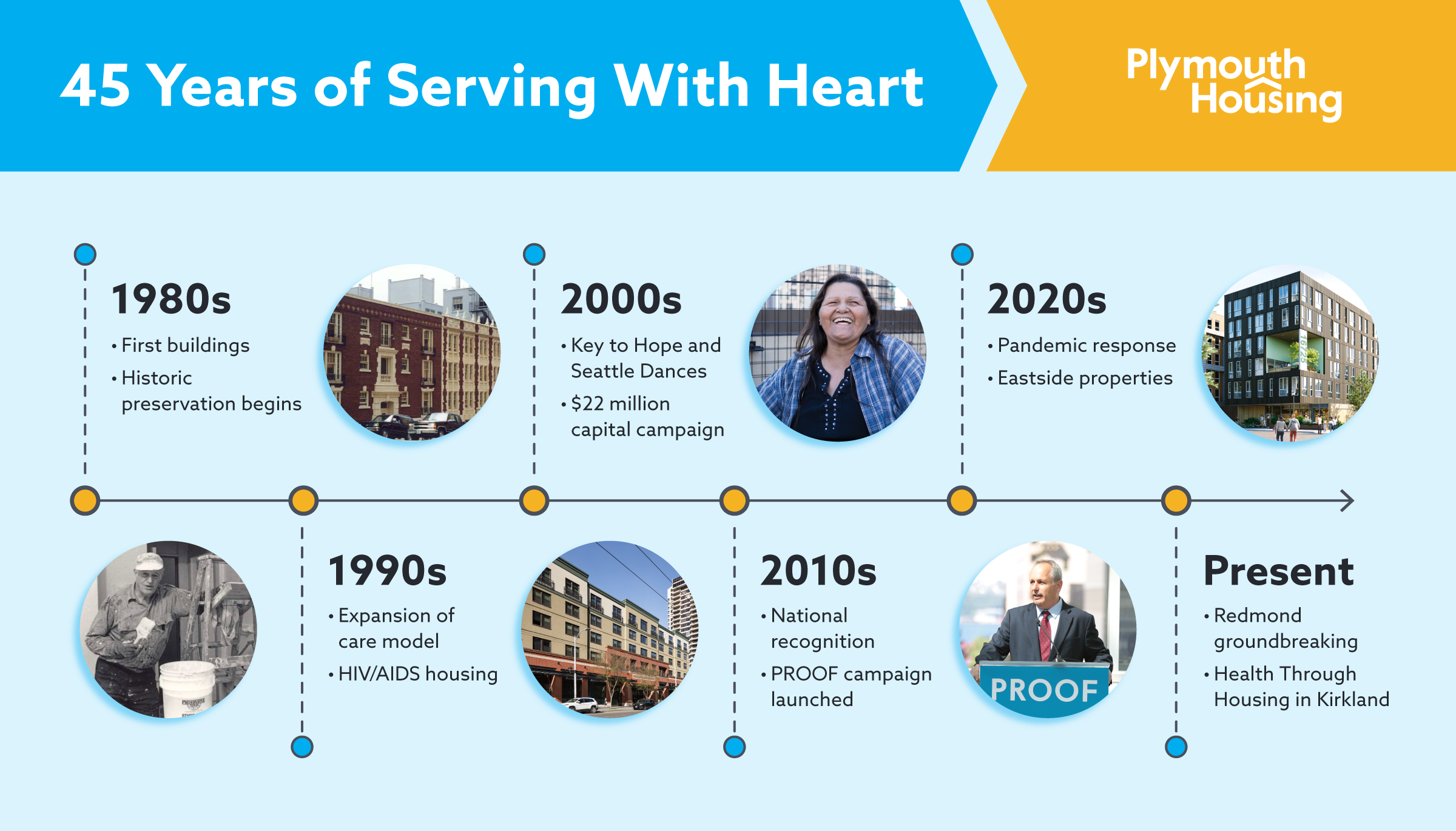
In 2025, Plymouth is proud to celebrate 45 years of service in King County. Learn more in this post about how Plymouth’s legacy has grown over the decades as we’ve become one of the region’s foremost providers of housing and wraparound support for people in need.
Plymouth’s beginnings: 1980s
In 2025, Plymouth owns or operates 17 apartment buildings in Seattle and the Eastside, with more underway. It all began with the Seven Seas Building — renovated in 1981 into low-income housing by Plymouth and still standing today (though no longer part of Plymouth).
“David [Colwell] just walked into a meeting and said he’d found it. That’s the way he was — visionary and action-oriented,” said Plymouth co-founder Nancy Smith in a 2001 Seattle Times interview.
From there, Plymouth developed housing in five more buildings before rehabilitating the historic Scargo Hotel in 1988. Without Plymouth’s efforts, many of these buildings might have been destroyed or forgotten; instead, they were converted into much-needed housing supply.
Plymouth was part of a broader movement in the 1980s, when several Seattle nonprofits created or transformed historic properties into 2,000 low-income units. Voter-approved tax increases, spurred by a late-1970s housing crisis, helped fund these efforts. The Housing Levy, first passed in 1986, remains a key funding source for housing in Seattle — especially vital as the tech boom drove home prices sharply upward beginning in the 1980s, with costs continuing to rise in the present day.
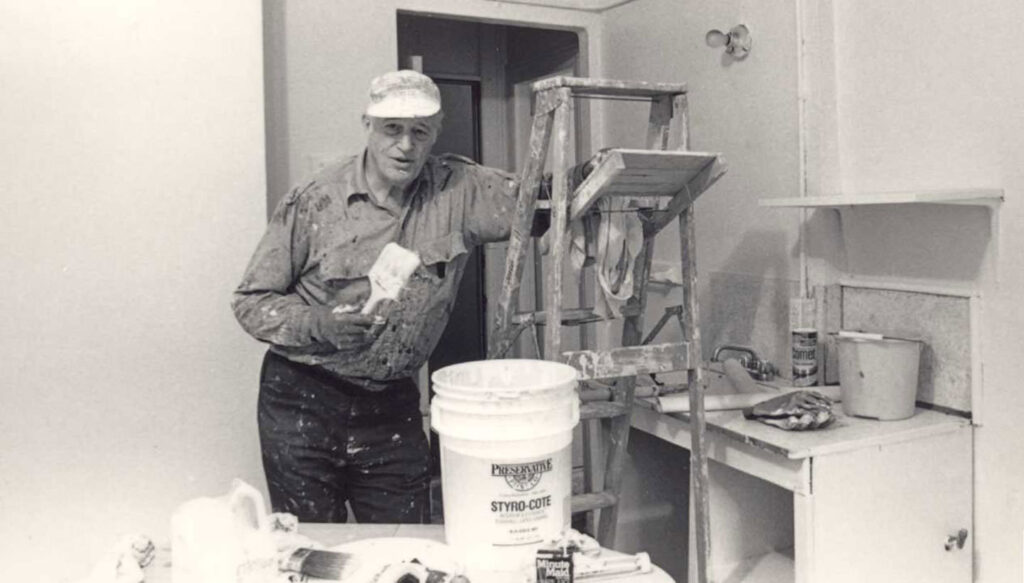
Rev. David Colwell paints one of Plymouth’s first apartments; fellow congregants also helped out
Wraparound services: 1990s
In our second decade, Plymouth deepened its commitment to residents and laid the groundwork for long-term growth. By the mid-1990s, we had developed more than 600 housing units and managed seven buildings in downtown Seattle. One of these was the Pacific Apartments, formerly the vacant and deteriorating Leamington Hotel.
In 1993, a peaceful protest led by Operation Homestead, including people with lived experience of homelessness, spotlighted the injustice of empty buildings amid a housing crisis. Their advocacy helped Plymouth acquire and renovate the Pacific in 1995, earning an Outstanding Achievement Award in Historic Preservation. The building still serves residents today and is undergoing new renovations.
Plymouth also introduced supportive services to our care model, partnering with agencies across Seattle to provide medical services, mental health care, and community connections. Critically, Plymouth provided housing for people with AIDS during a time when it was needed most.
We also became the first housing provider in the nation to implement Shelter Plus Care, linking rental assistance with services for formerly homeless individuals. Today, Plymouth still works with property managers throughout King County to help get people housed throughout the region.
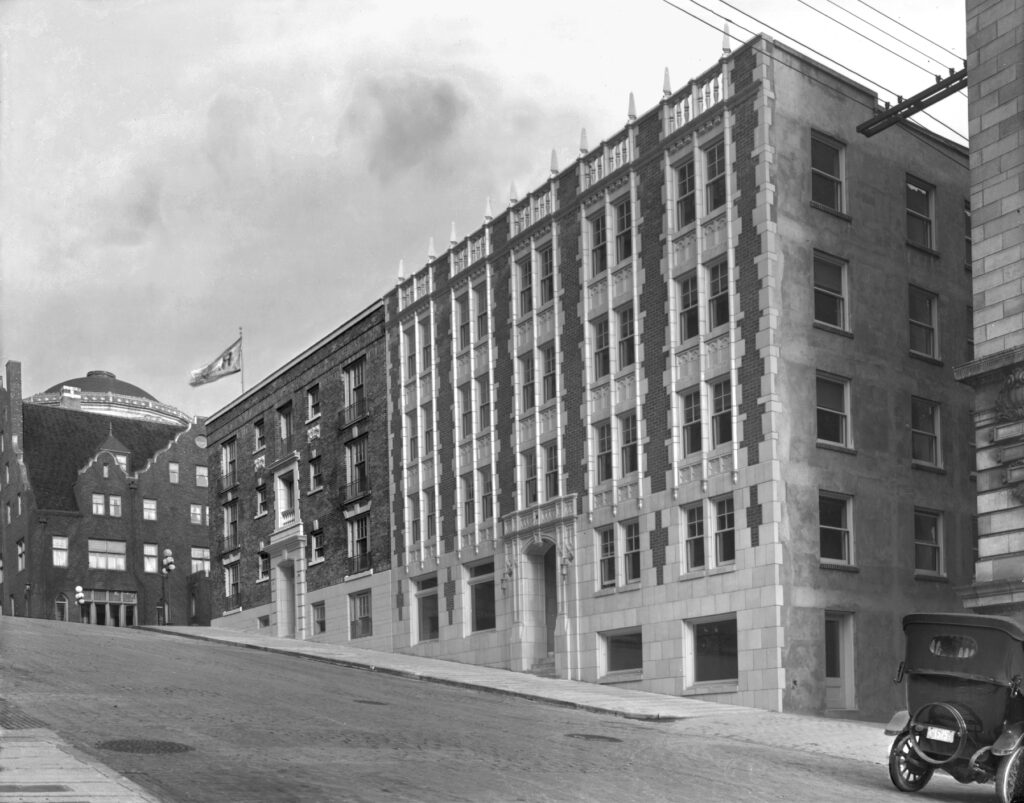
The historic Pacific Hotel
Meeting the moment: 2000s
By 2000, Plymouth owned and managed 10 buildings and would add four more over the next decade — including the Langdon & Anne Simons Senior Apartments in Belltown. Simons provides on-site medical care and housing for people 55+ who have experienced homelessness, with many units reserved for veterans. When the building opened in 2008, one in five shelter or transitional housing users was over 55 — a number that has since grown.
“As baby boomers are aging, so is the homeless population,” then–Executive Director Paul Lambros told The Seattle Times in 2008. Today, nearly 60% of Plymouth residents are over the age of 55.
During this period, Plymouth expanded partnerships with corporations, foundations, and individuals to rehabilitate vacant or deteriorating buildings. A major milestone was the $22 million Sustaining Hope Capital Campaign, which funded renovations of the Lewiston and Pacific Apartments downtown and construction of the Pat Williams Apartments, a recovery-focused building in South Lake Union.
Plymouth launched its annual Key to Hope luncheon in 2003, bringing together community leaders and advocates to support solutions to homelessness. In 2009, we debuted Seattle Dances, an annual dance performance and competition that has raised millions for our mission.
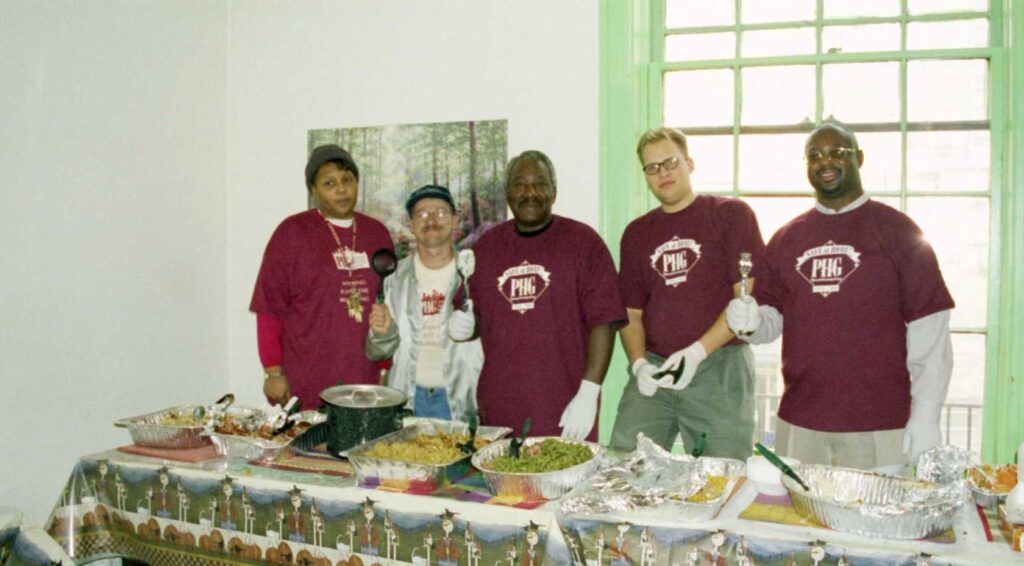
Plymouth staff serve a meal circa 2001. (Find one of our former logos on their t-shirts.)
Expanding our reach: 2010s
Over the next several years, Plymouth opened four new buildings and became one of downtown Seattle’s largest low-income housing providers, operating 14 buildings for more than 1,200 residents and 17 retail tenants. Our integrated model — permanent housing with wraparound services — earned local and national recognition for its effectiveness in ending chronic homelessness.
In 2013, we launched the Promoters of Plymouth Ambassador Board to engage rising leaders and young professionals in our mission. These dedicated volunteers have since involved our community in dozens of memorable events and experiences to broaden support and understanding of our work.
In 2019, we launched the PROOF campaign, an ambitious capital effort to fund hundreds of new permanent supportive housing units over the next decade.
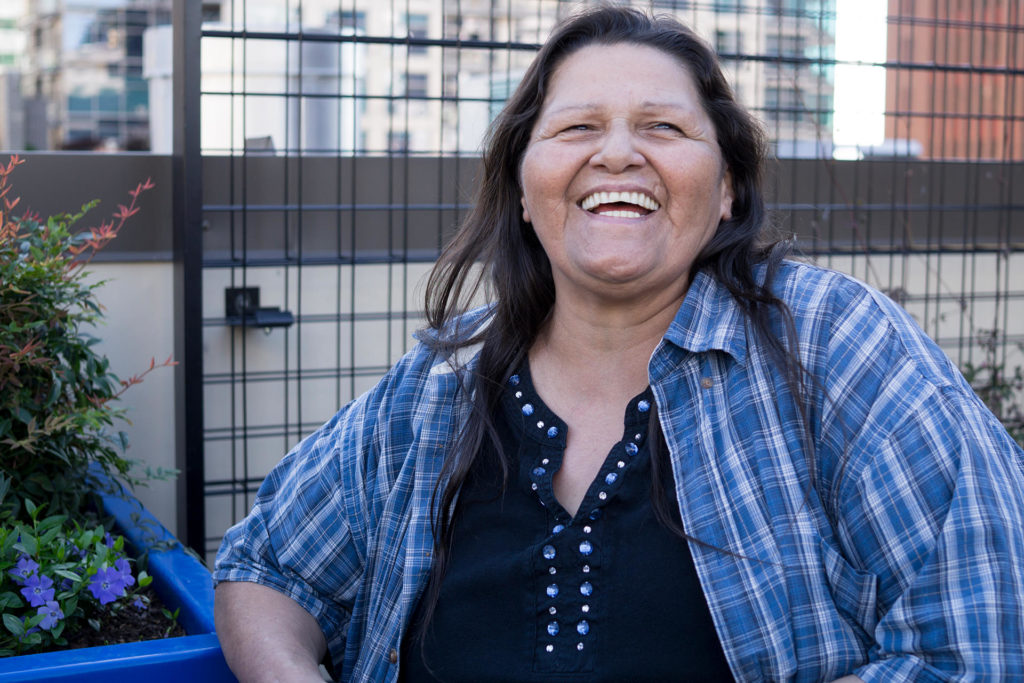
Judy, a Plymouth resident and volunteer, in 2018
A new era: 2020s
The next decade began with the height of the COVID-19 pandemic. Plymouth responded swiftly and comprehensively to serve residents — many of whom faced heightened health risks due to pre-existing conditions. Amid the uncertainty, our staff and residents found creative ways to stay connected, reinforcing Plymouth’s deep commitment to community, dignity, and care.
In August 2020, we celebrated the successful completion of the PROOF campaign, which raised $59.1 million from nearly 700 individuals, foundations, and corporations — including Microsoft, Amazon, Providence St. Joseph Health, Swedish Health Services, and Premera Blue Cross. The campaign funded six new buildings, adding 600 permanent supportive housing units to our region.
In the years that followed, Plymouth constructed and welcomed residents to these new buildings. One of them, Plymouth Crossing in Bellevue, marked two milestones. It was our first Eastside property and the first permanent supportive housing development in Bellevue, addressing the growing need for housing solutions beyond Seattle’s urban core.
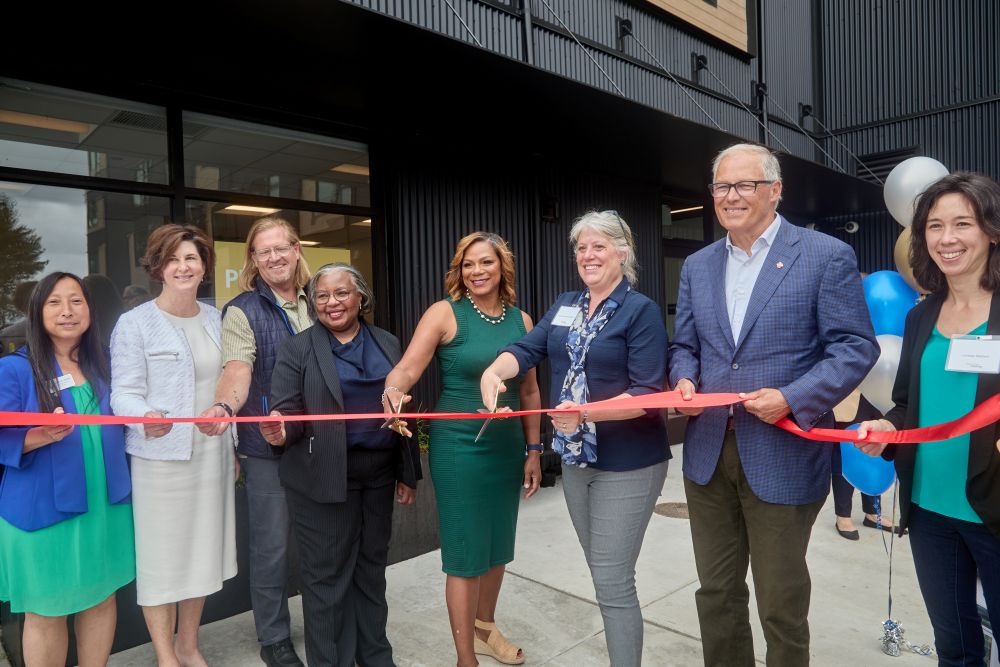
2023 grand opening of Plymouth Crossing, a PROOF campaign property, in Bellevue
Present day
Looking ahead, 2025 will be another landmark year. We will break ground on a new building in Redmond. We will complete a renovation of the historic Pacific Apartments. And finally, we will begin operating a Health Through Housing site in Kirkland — part of King County’s initiative to create up to 1,600 units of permanent supportive housing across the region.
Halfway through the decade, Plymouth continues to grow and adapt, even as the political landscape makes advocacy more challenging. Through it all, our mission remains unwavering. Plymouth’s legacy of resilience, consistency, and innovation ensures that we will continue to be a trusted, stabilizing force in the fight against homelessness for years to come.